

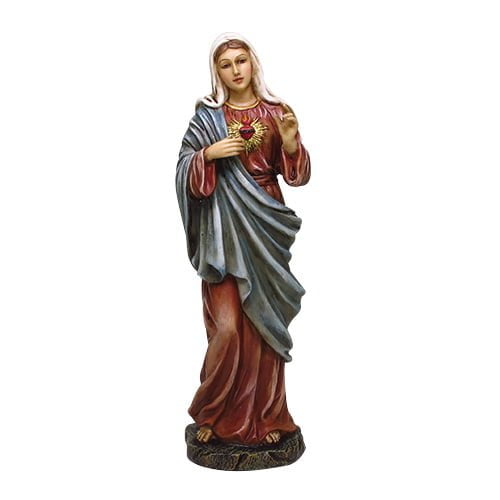

Sacred Heart of Mary Statue
Mother Mary is the mother of Jesus the Christ. She was a wise woman with a sacred heritage and fulfilled her purpose to give birth to the son of God.
The Immaculate Heart of Mary (Sacred Heart of Mary) is a Roman Catholic devotional name used to refer to the Catholic view of the interior life of Mary, mother of Jesus, her joys and sorrows, her virtues and hidden perfections, and, above all, her virginal love for God the Father, her maternal love for her son Jesus Christ, and her motherly and compassionate love for all mankind.[1] Traditionally, the Immaculate heart is depicted pierced with seven wounds or swords, in homage to the seven dolors of Mary and roses,[2] usually red or white, wrapped around the heart.
The Eastern Catholic Churches occasionally utilize the image, devotion, and theology associated with the Immaculate Heart of Mary. However, this is a cause of some controversy, some seeing it as a form of liturgical Latinisation. The Roman Catholic view is based on scripture, particularly the Gospel of Luke. From Wikipedia
“On a personal note, I learned about Ladybug as a child from my mother. She was the first to inform me that this charming little insect is also known as the Mary beetle or Our Lady’s beetle. They got this name from a story dating back to the Middle Ages when food crops were being ravaged by insects. Farmers and villagers prayed to Mother Mary for help, and very soon, ladybugs arrived and ate the offending insects. Therefore, on a spiritual level, when Ladybug shows up in the garden of your life, it is a message to open your sacred heart and petition the blessings and help from Mother Mary or the Divine Feminine. When Ladybug flies into your life, know that you are blessed with good luck and all that is good.” ~an excerpt from Animal Totems and the Gemstone Kingdom by Margaret Ann Lembo
Honoring Mother Mary: The Assumption, Dormition, and Aquamarine by Margaret Ann Lembo
Like Enoch and Elijah, Mother Mary, the Mother of Jesus the Christ, was assumed into heaven by the power of God. Upon her natural death, Mother Mary’s soul was received by Christ and she, too, had her body resurrected on the third day after her death. At that time her body was taken up into heaven. Like her son, Jesus the Christ, her tomb was found empty on the third day. The Assumption is celebrated on August 15. According to Eastern and Orthodox Churches, which falls around the same time on the calendar, Mary’s passing is considered the Dormition of the Mother of God. Dormition indicates that Mary died  without suffering in a state of spiritual peace.


